
Building a modern skyscraper usually means pouring wet concrete under the burning sun. However, shifting your focus to Dubai Precast Careers means stepping into a completely different side of the construction industry. Instead of building on the dirt, you are working in a massive manufacturing yard where entire walls, staircases, and roof slabs are produced like giant Lego pieces before being shipped to the final location.
Working in a precast concrete facility is highly organized but physically demanding. Whether you are in the casting yard or on the installation site, the daily routine involves:
- Setting up complex steel and wooden molds to shape thousands of tons of wet concrete.
- Operating heavy batching plants and overhead gantry cranes to move finished panels.
- Assembling massive concrete structures on active sites, relying entirely on heavy riggers and mobile cranes.
Many tradesmen actually prefer working for a precast supplier rather than a general builder. The reason is the work environment. A large portion of the job happens inside shaded factory sheds (casting yards) rather than out in the open desert. Furthermore, because precast companies are specialized suppliers with massive corporate contracts, their workers generally experience more stable and on-time salary payments.
If you want to move out of general site labor and into specialized concrete manufacturing, you need to show the right skills. Here is the breakdown of the 2026 factory pay grades, the strict lifting safety rules you must know, and the direct route to get your CV into the right hands.
Our Professional Verdict: The Precast Reality
Our Analysis: Dubai Precast operates in two completely different worlds: The Casting Yard (Factory) and the Erection Site (Installation). If you apply for a factory role, you will deal with concrete dust, loud vibrating tables, and daily production targets. If you apply for an erection role, your life revolves around massive mobile cranes and extreme safety hazards while connecting 10-ton walls high in the air.
Expert Pro Tip: “The Specialized Rigger.” Standard construction helpers are rarely trusted to lift precast panels. If you are applying for a site role, you must prove you know how to balance massive, off-center weights. Highlight “TUV CERTIFIED HEAVY RIGGER & PRECAST ERECTION EXPERIENCE” at the top of your resume. For yard workers, emphasizing “Precast Mold Carpentry” will instantly get you an interview.
Advertisements
Job Overview: Salary & Benefits (2026 Estimates)
Note: Precast factories often run on 24-hour shift rotations. Base salaries are heavily supplemented by production bonuses in the yard and heavy overtime during site installation phases.
| Target Role | Est. Monthly Salary (AED) | Key Benefits |
| Precast Carpenter / Steel Fixer | 1,200 – 1,600 AED | Free Camp Accommodation |
| Heavy Trailer Driver (Flatbed) | 2,500 – 3,500 AED | Company Bus Transport |
| Certified Rigger / Crane Operator | 2,800 – 4,500 AED | Yard Production Bonuses |
| Concrete QA/QC Inspector | 4,000 – 6,500 AED | Premium Medical Insurance |
| Precast Erection Foreman | 5,000 – 8,000 AED | Annual Flight Ticket Home |
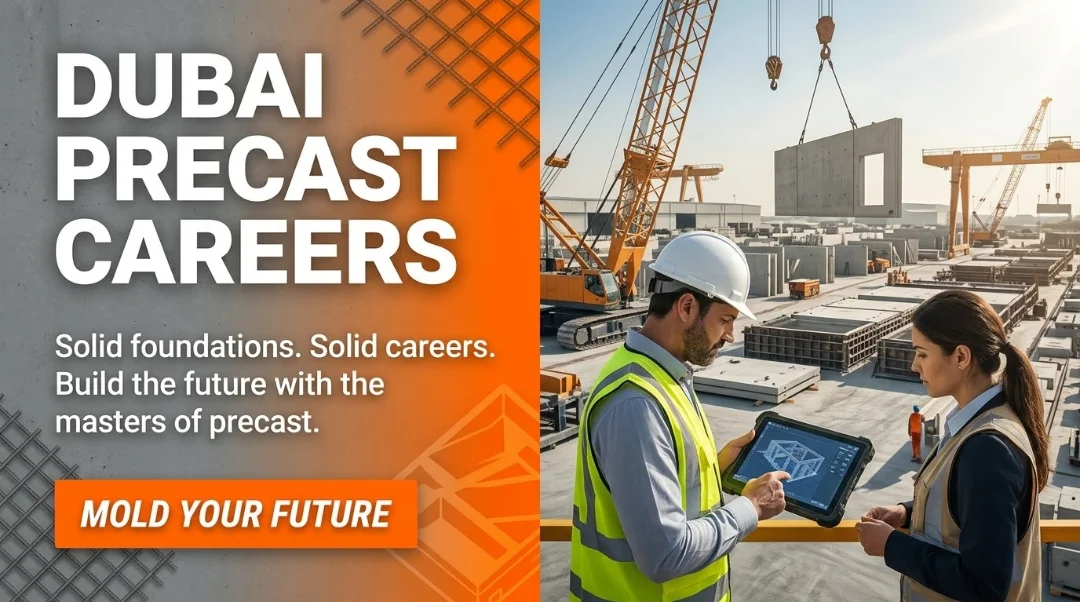
Inside the Operations: Active 2026 Hiring Zones
A precast company is essentially a heavy manufacturing plant and a transport fleet combined. Based on your trade tests, the production manager will assign you to one of these three main areas:
1. The Casting Yard (Production)
- Factory Floor Trades: Shuttering Carpenters, Steel Fabricators, Concrete Finishers, and Gantry Crane Operators.
- The Daily Process: This is where the heavy work starts. You will oil massive steel molds, tie rebar cages, and pour wet cement. Once it dries, loud vibrating machines are used to shake out air bubbles and make the panel smooth.
- Physical Demands: It is an incredibly dusty and noisy indoor environment. Carpenters also need to read exact millimeter measurements from shop drawings to build the molds correctly.
2. Concrete Quality Control (QA/QC)
- Lab & Testing Staff: Lab Technicians, Concrete Batching Plant Operators, and QC Inspectors.
- The Testing Routine: Precast walls must be perfectly strong, or the final building will fail. Lab techs spend their day taking wet cement samples, doing “slump tests,” and crushing dried concrete blocks in testing machines.
- Strict Qualifications: You need a flawless eye for detail and a valid Civil Engineering or Material Testing diploma. Approving a bad batch of concrete can cost the factory thousands of Dirhams.
3. The Site Erection & Logistics Team
- Transport & Lifting Crew: Heavy Flatbed Drivers, TUV Certified Riggers, Erection Supervisors, and Structural Welders.
- The Installation Shift: Heavy drivers transport the finished walls through Dubai traffic to the client’s site. There, the erection team uses mobile cranes to lift the massive blocks into the sky, and welders lock the steel joints together.
- Zero-Tolerance Safety: Riggers must hold valid third-party lifting certifications (like TUV). A snapped lifting cable or a swinging 10-ton concrete wall can cause fatal accidents instantly.
The Reality of Working in UAE Concrete Manufacturing
Making the jump from a standard indoor warehouse to a heavy concrete facility is a massive shock to the system. You are no longer dealing with cardboard boxes. If you are applying for manufacturing jobs in the UAE, especially within a heavy factory setup, you must adapt to an extreme safety culture. Even for an experienced heavy driver, handling 15-ton concrete loads makes these logistics jobs in Dubai incredibly dangerous if protocols are ignored.
Before you step onto the yard, you need to understand what you are actually signing up for:
- Walking Under Suspended Tonnage: A single precast wall is dangerously heavy. In the casting yard, you are constantly working near overhead gantry cranes moving wet and dry concrete. A slipping hook or a snapped cable is a fatal crush hazard, meaning 100% spatial awareness is mandatory on the floor.
- Surviving the Production Sheds: The air inside these facilities is thick with fine cement dust. Add the deafening, non-stop noise of concrete vibrating machines, and the physical toll becomes obvious. Workers must wear strict PPE (respirators and heavy ear muffs) for up to 12 hours a day in this highly gritty environment.
- Relentless Dispatch Targets: Securing production jobs at tier-one suppliers like Dubai Precast means your team is bound by strict client deadlines. If a site manager needs 50 panels delivered by Tuesday morning, the yard simply runs continuous night shifts. The machines do not stop until the daily target is met.
Featured Hot Job: Precast Erection Rigger
Dubai Precast is actively looking for experienced heavy riggers to safely manage the offloading and installation of massive concrete elements on their active tower projects. Because lifting 10-ton walls requires perfect balance, they are only hiring certified professionals.
- Estimated Monthly Pay: 2,800 – 4,000 AED (Basic + Site Overtime).
- Primary Worksite: Active Construction Sites (UAE Region).
Hard Requirements (Non-Negotiable):
- The Technical Mix: Must hold a valid TUV (or equivalent third-party) Heavy Rigging and Slinging certification.
- Equipment Knowledge: Proven ability to inspect lifting gears (shackles, wire ropes, webbing slings) and use professional hand signals to guide crane operators blindly.
- Experience: A minimum of 3 years in the GCC handling heavy precast concrete erection or structural steel lifting.
How to Apply Correctly? (The Industrial Route)
Getting a job at a specialized concrete factory requires a different approach than applying for regular street-level construction work. Because they need highly specific industrial skills, Dubai Precast relies on strict, almost hidden hiring channels.
Method 1: The Corporate Portal (For Technical Roles)
For roles like QA/QC Inspectors, TUV Riggers, and Heavy Drivers, direct application is the only way in.
- Step 1: Visit the Dubai Precast official careers website.
- Step 2: The “ATS Keyword” Hack: A generic construction CV will be rejected. Make sure words like “Hollowcore,” “GFRC,” “Pre-stressed Concrete,” and “Batching Plant” appear prominently in your experience section.
- Step 3: Highlight specific GCC certifications. If you are a Rigger, explicitly mention your “TUV Certification.” For Heavy Drivers, write “UAE License Category 4 & 8” at the very top of your profile.
Method 2: Industrial Manpower Agencies (The Factory Floor Route)
Unlike general builders, precast factories almost never host open walk-in interviews at their main gates due to strict heavy-machinery safety rules. They outsource bulk hiring.
- Action: Contact major UAE manpower supply agencies that specialize in industrial labor.
- Tip: If you are looking for roles like Shuttering Carpenter, Steel Fabricator, or Concrete Pourer, registering with top industrial recruiters in Dubai is your best ticket to getting placed directly in their massive casting yards.
Method 3: LinkedIn (Connecting with Production Heads)
If you are applying for a supervisory role, Erection Foreman, or Logistics Manager, standard HR emails take too long.
- Step 1: Search the Dubai Precast LinkedIn directory for “Casting Yard Manager” or “Production Head Dubai Precast”.
- Step 2: Do not send a generic “Please find my CV” message. You need to show immediate value.
- Step 3: The Connection Note: “Hi [Name], I’m a [Your Profession] with 5 years of GCC experience in pre-stressed concrete production. I am currently in the UAE, available immediately, and would love to bring my expertise to your casting yard team.”
- Why: Production managers often need immediate replacements to hit daily casting targets and will frequently bypass standard HR queues to get the right technical guy on site.

Haris Khan is the lead content expert at TheEmiratesGuides.com, where he oversees the documentation of UAE visa processes, employment opportunities, and government services. With a commitment to factual integrity and real-time updates, he provides the technical expertise necessary to guide readers through the complexities of life and work in the UAE.