
Even though the inland fields are now managed under the ADNOC Onshore banner, engineers still actively apply for ADCO Careers to gain long-term financial security in the UAE.
But surviving at these remote desert facilities is not a standard corporate job; it is a brutally hot, physically draining daily grind.
Advertisements
If you work as an onshore roughneck, you are handling heavy drill pipes for 12 hours straight under the intense summer sun at the Bab field. If you operate as a plant technician, your reality involves navigating high-pressure gas lines while wearing suffocating fire-retardant coveralls.
The core advantage, however, is the premium compensation. You secure high-tier desert allowances, fully covered camp housing, comprehensive family medical coverage, and strict rotational leave cycles.
Before you pack your bags for a remote camp deployment, here is the unfiltered reality of onshore drilling, the 2026 industrial pay scales, and the exact digital tactics to get hired.
Our Professional Verdict: Onshore (ADCO) vs. Offshore
Competitor Analysis: Working for ADCO (ADNOC Onshore) provides a vastly different lifestyle compared to offshore branches like ADNOC Offshore or NPCC. While offshore workers are entirely isolated on marine barges for weeks, onshore staff at fields like Bu Hasa or Asab live in highly developed desert cities. You have access to better recreational facilities, reliable ground transport, and you do not have to endure the seasickness or helicopter transfers associated with marine rigs.
Expert Pro Tip: “The H2S & CICPA Necessity.” You cannot step foot on an Abu Dhabi oilfield without passing a strict security background check to obtain a CICPA pass. Furthermore, onshore fields carry a high risk of sour gas. Highlighting an active or recently expired H2S (Hydrogen Sulfide) Breathing Apparatus Certification on your CV instantly bumps you up the HR shortlist, as it saves the company mandatory training costs.
Job Overview: Salary & Desert Benefits (2026 Estimates)
Note: Base salaries in the onshore sector are heavily multiplied by remote location allowances, hazard pay, and strict rotational overtime metrics.
| 🛢️ Target Role | 💵 Est. Monthly Salary (AED) | 🎁 Key Benefits |
| Rig Helper / Roustabout | 2,500 – 3,800 AED | Free Desert Camp Housing |
| Mechanical Technician | 5,000 – 8,000 AED | 3 Daily Catered Meals |
| Onshore Field Operator | 9,000 – 15,000 AED | 28/28 or 42/21 Rotation Cycle |
| HSE Safety Officer | 12,000 – 18,000 AED | Premium Health Insurance |
| Drilling Supervisor | 35,000 – 55,000 AED | Paid Rotational Flight Tickets |
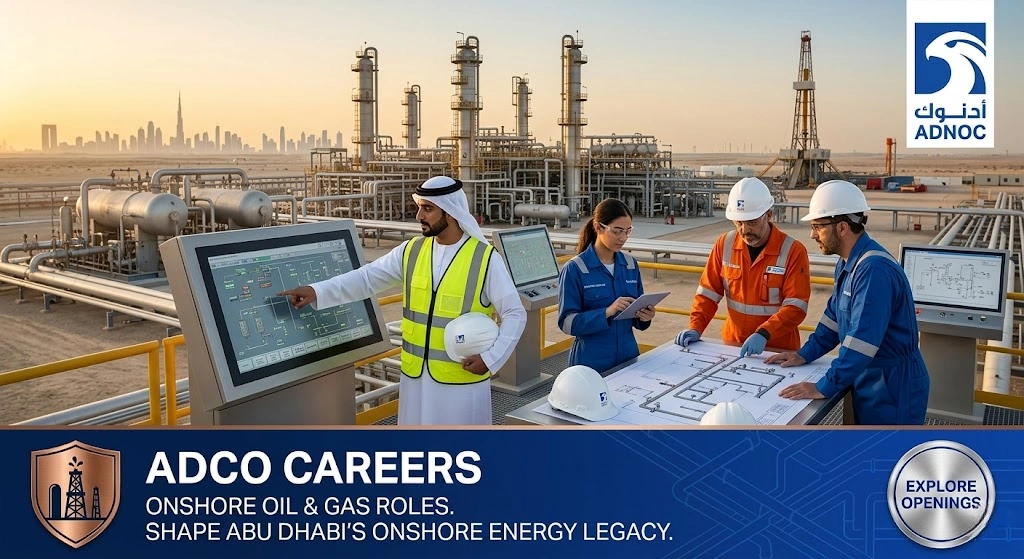
Core Onshore Zones: Drilling, Maintenance & Processing
An energy operator managing sprawling desert territory does not hire through a single pipeline. You need to align your application with the specific operational zone that matches your technical trade:
1. The Desert Rigs (Drilling & Extraction)
- Targeted Ground Staff: Roughnecks, Derrickmen, Mud Engineers, Rig Managers.
- The Ground Reality: You are pulling the oil directly from the earth. The work environment features extreme dust storms, blinding summer heat, and the constant physical danger of swinging iron and high-pressure blowouts.
- Safety Protocols: Absolute adherence to ADNOC Life-Saving Rules. Failing to secure a harness or bypassing a safety lock-out tag results in immediate removal from the rig and permanent termination.
2. Processing Plants & Pipeline Maintenance
- Required Personnel: Safety Officers, Instrument Technicians, Plant Operators, Welders.
- The Field Hustle: Operating out of central processing facilities in Habshan or Shah. You are repairing heavy industrial valves, executing scheduled plant shutdowns, and monitoring localized gas leaks.
- Technical Demands: Technicians must hold highly specific vocational diplomas and demonstrate the ability to read complex P&ID (Piping and Instrumentation Diagrams) directly on the ground.
3. Camp Logistics & Administration
- Key Support Staff: Camp Bosses, Fleet Drivers, Medics, Logistics Coordinators.
- Operational Flow: Keeping a remote desert city of thousands of workers alive and functioning. You will manage water deliveries, resolve disputes in the labor dormitories, and coordinate emergency medical evacuations.
- The Stress Factor: You are on-call 24/7. If the camp air conditioning fails in July, or if the catering supply truck is delayed, you bear the full brunt of the workforce’s frustration.
The Unfiltered Reality of UAE Petroleum Jobs
Expats hunting for oil and gas vacancies in the UAE often focus entirely on the high salary figures. The reality of onshore extraction is pure mental endurance and physical isolation.
If you secure one of these field operations contracts, your personal life will take a back seat. Even on a favorable 28/28 rotation (28 days on, 28 days off), you will miss family birthdays, holidays, and milestones. During your 28 days on duty, you work 12 hours a day, every single day, with zero weekends.
For those targeting site HSE roles, the pressure comes from management audits. You are constantly battling aggressive drilling supervisors who want to cut corners to save time, while you bear the legal responsibility if an accident triggers an Abu Dhabi government investigation.
Featured Hot Job: Onshore Field Operator
ADCO (ADNOC Onshore) frequently recruits highly alert field operators to monitor pressure gauges, execute valve line-ups, and ensure the safe flow of crude oil across their remote desert facilities.
- Estimated Monthly Pay: 9,000 – 15,000 AED (Base + Desert Allowance).
- Primary Worksite: Remote inland fields (Bab, Bu Hasa, Asab, Sahil).
Strict Criteria (Non-Negotiable):
- The Technical Background: Minimum of 4 years of verifiable experience operating live upstream oil and gas processing plants. You must understand sour gas (H2S) environments intimately.
- The Physical Requirement: High stamina to execute frequent perimeter walks across sprawling outdoor plants in 45-degree heat, manually cranking heavy industrial valves.
- The Security Clearance: A completely clean criminal and financial record to successfully clear the mandatory Abu Dhabi CICPA background check prior to deployment.
3 Ways to Get Hired: The Corporate ATS & Field Sub-Contractors
If you just email a resume with a basic subject line like “Looking for Rig Job,” you are going to be ignored. The UAE energy sector is heavily regulated, and a company like ADNOC Onshore deals with an immense volume of daily applications. To get past the rigid industry filters, you need a highly precise strategy:
- Mastering the Central ATS (For Engineers & Management)
ADNOC Onshore handles all of its senior technical and white-collar recruitment through its own dedicated digital tracking system.
- Highlighting Certifications: The automated HR software scans strictly for industry-standard qualifications. Make sure your technical credentials, such as “NEBOSH IGC” or “Certified in P&ID Analysis,” are bolded and immediately visible.
- Production Data: Cut out the vague daily duties. Show your exact operational capacity with hard metrics, like: “Monitored a 50,000 bpd crude separation unit with zero unplanned shutdowns.”
- The EPC Contractor Backdoor (For Tradesmen & Technicians)
National oil companies almost never hire thousands of individual riggers, welders, or fitters directly. This heavy volume of hiring is outsourced to registered local manpower suppliers.
- Shift Your Focus: Instead of sending applications to ADCO directly, focus your energy on the major EPC contractors operating on their desert fields.
- Key Suppliers to Target: Submit your profile to established companies like Al Masaood Oil & Gas, Ali & Sons, or Galfar Emirates. Getting hired by these supply giants is the most realistic way to secure an entry pass into the ADNOC onshore camps.
- Direct Outreach to Field Leadership (Supervisors & HSE Leads)
Senior plant operators, HSE leads, and supervisory staff can bypass the heavily congested HR queue by pitching directly to the engineers who run the specific sites.
- Locating the Leaders: Jump on LinkedIn and search for the exact site decision-makers. Try finding titles like “OIM Bab Field” (Offshore/Onshore Installation Manager) or “Maintenance Superintendent ADNOC Onshore.”
- The Tactical Pitch: Send a direct message that proves your reliability during critical operational periods. Try something like this:
“Hello [Name], I know the upcoming plant shutdowns demand highly reliable site supervision. I am a CICPA-cleared Plant Operator currently based in Abu Dhabi. At my previous company, I managed a 12-man field team, cut flaring incidents by 15%, and maintained flawless H2S safety compliance. I would love to connect for a technical chat this week to discuss how I can support your operations.”

Haris Khan is the lead content expert at TheEmiratesGuides.com, where he oversees the documentation of UAE visa processes, employment opportunities, and government services. With a commitment to factual integrity and real-time updates, he provides the technical expertise necessary to guide readers through the complexities of life and work in the UAE.