
Walk past the crowded wave pools at Aquaventure Waterpark or the luxury infinity pools overlooking Jumeirah Beach Residence (JBR). If you are a strong swimmer with high stamina, applying for Lifeguard Jobs in Dubai offer a very straightforward entry into the city’s booming hospitality sector.
But let’s completely kill the “Baywatch” fantasy right now, because this job is physically brutal. You will not be casually jogging on the sand in slow motion; you will be standing in blistering 50°C summer heat while staring at glaring water for nine hours straight.
Advertisements
You will deal with tourists who ignore basic safety rules, and your skin will constantly suffer from the chlorine and extreme UV exposure. If a child slips under the water for even ten seconds on your watch, the Dubai Police and hotel management will hold you strictly accountable.
If you can survive the intense physical demands and strict EIAC (Emirates International Accreditation Centre) licensing tests, hotels will provide your housing and meals. Let’s break down the actual Dirhams you can earn, why open-water roles pay more, and how to avoid the cheap third-party facility companies.
Our Professional Verdict: 5-Star Resorts vs. 3rd Party Agencies?
Our Analysis: Freshers often sign contracts with third-party facilities management (FM) companies that supply pool guards to residential buildings in Discovery Gardens or JVC. These companies pay a very low basic salary (around 1,200 to 1,500 AED) and rarely provide good cooling gear. You must target the major 5-star resorts or huge waterparks like Atlantis The Palm. They pay much better (2,000+ AED), offer monthly service charge distributions, and actually rotate your position into shaded areas every 45 minutes so you don’t pass out from heatstroke.
Expert Pro Tip: You cannot legally guard a pool in Dubai without an EIAC-approved Lifeguard Certificate. If your CV clearly states that you already hold an active UAE certification (like Ellis & Associates or Highfield), HR recruiters will call you almost immediately because they save thousands of Dirhams on your training.
Job Overview: Salary & Benefits (2026 Estimates)
| Role | Est. Monthly Salary | Focus Area |
| Junior Pool Lifeguard | 1,200 – 1,800 AED | Residential pools / Low pay |
| Waterpark Lifeguard | 2,000 – 2,800 AED | High action / Service charge included |
| Beach / Open Water Guard | 2,500 – 3,500 AED | Ocean currents / Elite fitness |
| Recreation Supervisor | 4,000 – 6,000 AED | Managing the roster & chemical checks |
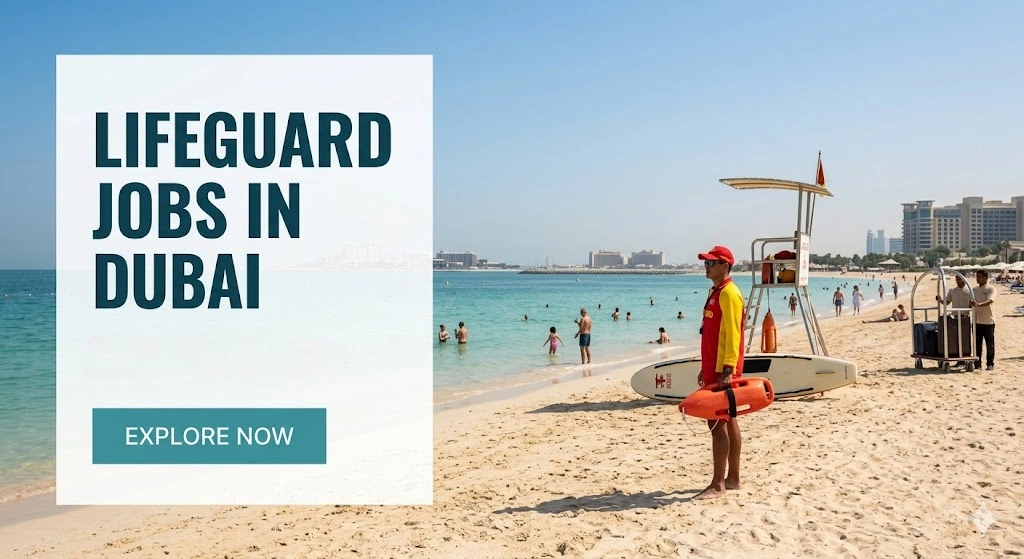
Available Lifeguard Positions in Dubai (2026)
Being a lifeguard means different things depending on where you are assigned. Here is what you are actually signing up for:
The Residential Pool Guard (The Lonely Shift)
Working for FM companies at apartment buildings or community centers.
- Daily Tasks: Skimming dead leaves out of the water, checking chlorine levels, and telling angry residents that the pool is officially closed at 10:00 PM.
- The Reality: It is incredibly boring. You sit alone for 10 hours with zero colleagues to talk to, and wealthy residents will often try to treat you like their personal servant.
The Waterpark Dispatcher (The Traffic Controller)
Working at intense entertainment hubs like Wild Wadi.
- Daily Tasks: Pushing heavy rubber tubes, managing slide queues, and blowing your whistle constantly to stop kids from running on wet concrete.
- The Pressure: You are dealing with thousands of screaming children daily. The noise level is deafening, and you must maintain hyper-focus because drowning incidents happen in seconds in crowded wave pools.
The Beach Lifeguard (The Elite Guard)
Working at public areas like Kite Beach or luxury beachfront resorts.
- Daily Tasks: Watching out for dangerous rip currents, putting up red flags for jellyfish warnings, and driving the rescue jet skis.
- The Environment: This requires elite physical fitness. You are battling actual ocean waves and the unforgiving sun, but it carries the highest respect and significantly better pay.
The Reality of “Heat, Labor Camps, and Red Hat Drills”
Do not jump into this career until you understand the physical toll.
- The Brutal Summer: From June to September, Dubai’s humidity and heat are downright dangerous. Your company will give you a sun hat and a water bottle, but you will still be sweating entirely through your uniform within the first hour of your shift.
- The “Red Hat” Drills: Getting the job is only step one. Every few months, your manager will run a surprise drill—they will secretly throw a dummy or a red hat into the pool to test your reaction time. If you fail to jump in within 10 seconds, you can be fired instantly.
- The Shared Labor Camps: Unless you work for a premium luxury hotel, you will be living in crowded labor camps in areas like Sonapur or Al Quoz. You will share a small room with up to six other guys and ride a hot, crowded company bus for an hour just to reach your pool.
Featured “Hot Job”: Beach & Pool Lifeguard (Atlantis)
Atlantis The Palm operates one of the largest and busiest waterpark resorts in the world. They are constantly looking for highly alert guards to ensure zero-incident safety across their massive pools and private beaches.
- Salary: 2,200 – 2,800 AED + Monthly Service Charge.
- Location: Palm Jumeirah.
- Benefits: Free duty meals, company-provided accommodation, health insurance, and full Ellis & Associates (E&A) recertification.
Requirements:
- Must be able to swim 50 meters in under 45 seconds.
- Ability to tread water for 2 minutes without using hands.
- Excellent 20/20 vision and strong conversational English.
How to Apply Correctly? (Skip the Scams)
You cannot just show up at a hotel pool with a whistle and ask for a job.
Method 1: The Assessment Days
Big waterparks and luxury hotel groups hold open “assessment days” before the winter tourist season begins (usually in August or September). You will literally be asked to jump into a deep pool, retrieve a 10-pound brick from the bottom, and swim laps. Be physically ready before you attend.
Method 2: Direct Hotel Portals
Go directly to the career pages of Jumeirah Group, Marriott, or Kerzner International. They hire their recreation staff directly and, most importantly, they process your EIAC license properly without cutting costs.
Method 3: Avoid the “Medical Test” Scammers
If a Facebook recruiter promises you a “direct lifeguard visa” but asks you to transfer 1,500 AED via Western Union for a “swimming test and medical clearance fee,” block them instantly. Legitimate Dubai companies pay for your medical exams and training; you never pay them.

Haris Khan is the lead content expert at TheEmiratesGuides.com, where he oversees the documentation of UAE visa processes, employment opportunities, and government services. With a commitment to factual integrity and real-time updates, he provides the technical expertise necessary to guide readers through the complexities of life and work in the UAE.